Sunday, June 15, 2008

By the Dead Sea: Masada & Ein Gedi

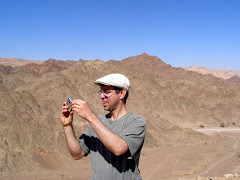
Tuesday afternoon David Sandberg, who is visiting me from the U.S.A., and I made our way across Jerusalem to the central bus station and got ourselves onto the bus that goes through the Jordan Valley to Eilat. It first heads east towards Jericho, skirting it to the south, and heads south past Qumran, Ein Gedi and Masada. We got off in Masada and went to the hostel there. The hostel was not the normal hole-in-the wall hostel. There was a nice pool and everything was emaculate. I noticed a plaque that mentioned that the Ministry of Tourism had a hand in it. That makes sense since Masada is an important symbol in Zionism.

For those who haven't read Josephus or seen the movie (also named Masada), the story takes place few decades after Jesus was crucified, during the Jewish rebellion that lead to the destruction of the temple in Jerusalem. A group of Jews, called Zealots, took refuge at Masada as it was clear that the Romans had quelled the rebellion. The Romans surrounded Masada and the 1,000 or so Jews who had taken refuge there. The Romans couldn't climb up the path because they would be picked off one by one so they built a seize ramp and eventually destroyed a wall and made their way in. The Jews, once they saw that they could not escape, killed themselves. The seize ramp still exists--it would have eroded faster but there isn't much rain in these parts.

Modern Israeli Zionists admire these 1st century Zealots for killing themselves rather than being taken slaves by the Romans but say "Masada will not fall again." The lesson being that Israel has to be strong to avoid the be killed or be captured dilemma. School children and soldiers are brought to Masada and taught about the lesson. For me, the place isn't so much about a lesson but it's an expression of the New Testament character Herod and illustrates something about about the historical period of time when Jesus was in the region--although he isn't reported to have visited this remote desert hideout.

After an early night we woke up around 4:00 a.m. and headed up the desert plateau. David had his caving headlamp on but after about 20 minutes, it was no longer necessary. The path, called the Snake Path, starts on the south-east of Masada and the climb isn't long nor particularly challenging. The views were worth slowing down for. Masada is directly west of the Dead Sea and there is a flat area between the Dead Sea and a row of plateaus to the west. The country of Jordan is on the other side of the Dead Sea.

We arrived at the top and my instinct for thoroughness kicked in and we headed to the north side to see the minor attractions. The highlight of that side was a cistern. We then made our way along the west side and encountered the synagogue and then the main attractions--a bathhouse and palaces. We made it back to the hostel in time for the 9:00 a.m. breakfast. Later that day, other hostel visitors arrived and our group room started living up to its name (we had been the only inhabitants of the room with 8 beds the night before). Since everyone hikes Masada before the sun rises to escape the heat, it was apparent that there was no escaping the ritual 4:00 a.m. wake up time.

I woke up early the next day to hike around, rather than up, Masada. I had a copied a hike description and basic map from a book--which ended up being accurate and informative except in one way that was later to become apparent. The hike was as expected until I arrived to the area southwest of Masada. There, I encountered a steep incline which lead up to Mount Eliazer--the mountain to the south of Masada. I managed to get to the top without much difficulty and enjoyed the sights of Masada across the gorge. Then I continued on to the other side of that mountain expecting to hike down to the hostel which was directly below. The hiking guide book mentioned that that portion of the hike was steep but did not elaborate further. It was apparent that it was not just steep but precarious. I decided to walk down a few meters to get a better view and this confirmed that me and my mild vertigo would not be fit for this descent. Not only did the path stay near a cliff as it switched back and forth down the hill, but I encountered a rock with hebrew writing on it and a wilted flower in a jar. The rock was a memorial to "our granfather [name forgotten] who died from on fall on such and such date." I was already leaning against the steep path and was the nail in the coffin. I turned back figuring that death was worth avoiding--even if it meant not making it back before the free breakfast buffet closed at 9:00 a.m. So I trekked back the same way. That usually would mean that I would see a while new set of scenery but this was thought of as a scenic hike from the start so I had already turned around and taken pictures many times. But the hike wasn't long and it was pleasant enough. It wasn't particularly hot even when I arrived near the end and asked someone what time it was. I was told it was only 8:15 a.m. so my breakfast was assured.

I returned to the hostel and we worked out a ride to Ein Gedi with some sojourners--a couple from England. They needed a nap though so I worked on my term paper for a while. We arrived at Ein Gedi around 2:30 p.m. and hiked up Wadi David. There was a stream with waterfalls and a lot of living things in an otherwise very barren area. We got to the top with time to spare so we decided to go back in a round about way. We made it over to the spring and Chacolithic temple. I subsequently read about the folks that lived in that period (c. 4300-3300 b.c.) and learned about their making copper things and about what they ate as well as some other things about them. I decided not to read the section of the chapter about their pottery. Near the end of the hike we made it to the Ein Gedi synagogue. I've been interested in churches and synagogues from around the time of Jesus until the moslem conquest so that was a bonus but then we were done. It was back to Jerusalem.

Tuesday, June 3, 2008

Weekend Trip to Jaffa and Tel Aviv

I couldn't really avoid Tel Aviv this time. After all this time, on and off, living in Jerusalem, a friend from the states was actually coming to visit. It's about a one hour project to get down there on public transportation so I could have made it an afternoon project but I decided to make it an excursion.

I looked up things to do in Tel Aviv in a way reminiscent of planning to visit sites in Los Angeles after having rarely been inclined to delve into the place all growing up. Like Los Angeles, I found some sites that could easily keep me entertained for a day or two. I talked to a friend who is also living in Jerusalem and we headed down for an afternoon walking around the old city of Jaffa and most of the next day going to museums in Tel Aviv.

We arrived and found the hostel in Jaffa and were told that there wasn't any room except in a tent on the roof. We probably would have chosen that in any case as it was cheapest and there was no possibility that we would be cold overnight in late May along Israel's coastal plain. We dropped off some stuff and walked around the old city, found a Bulgarian food restaurant to eat at--I found that appealing since I'll soon be passing through Bulgaria on a trip that includes Turkey and Greece. Then it was getting late and there wasn't much else to do. But my friend noticed a theater where something was happening. We crossed the street and found out that it was the Gesher theater--one of the two renouned professional theaters in the Tel Aviv area. We soon found out that the play was by Hanoch Levin--thought by many Israelis as the best playwrite modern Israel has produced. We paid our $20 (in shekels, of course) and went in. As we sat down, I asked our neighbors what the play was about and we discussed the playwrite for the 20 minutes until the play started. The play was professional but unusual. My friend is a science guy and seemed to not appreciate the virtue promoting theme under the crust of the play--a perspective that I find is rewarded in theater both ancient and modern. Nevertheless, he took it as a cultural experience. For me, it was a magic moment. I had heard of Levin and bought a book of a handful of his over 60 published plays but had never arranged to see one produced.

We woke up and after the expected interesting conversations with sojourners in the hostel, we walked along the coast from Jaffa to Tel Aviv. We were soon at the building where the Israeli declaration of independence occurred. It is a solid building that was described by the lecturer we stayed around to overhear as a bomb shelter. The table and chairs are left from the historic day and it was very informative.

The other objective as the Tel Aviv Museum of Art. My friend would soon be off to the Diamond museum as I headed to the airport and he talked as if he had some interest in the art but after I described some different eras and pointed out features of Cezanne, Chagall and Van Gogh's work, he sat on a bench waiting for me to get my fill.

I then asked a worker at the museum how best to get to the train station and was on my way. There are a few other museums in Tel Aviv that I'll try to get to but the couple of days helped me to come to terms with the big city on the coast. Like Los Angeles, there are things there that hold my attention for a day or two hear or there. But for much longer than a couple of museums and an ethnic restaurant, I prefer a smaller pond.

Monday, May 12, 2008

Around the Sea of Galilee

The bus from Jerusalem to Tiberias went along a highway that goes through an area of arab villages (within Israel) and is, at points, right next to the separation barrier between Israel and the West Bank. We then went west through Wadi Ara past the arab city of Umm al-Fahim. It was a bit memory lane for me as I had visited this area on a previous visit to Israel. We then went down the other side of the hill into the Jezreel Valley. I didn't see the archaeology site of Megiddo but thought a bit about Armaggedon and the future battle in that valley. Soon I saw Nazareth from the south (the main road on which we traveled goes through the Israeli city of Afula in the valley below. We stopped in Afula as is customary on long inter-city bus rides but I felt insecure about getting off in search of water (even though my bottle had been empty since Jerusalem). That was fortunate because the usual fifteen minute stop seem about half that long and I was left to wonder how many people ended their bus ride sooner than they had hoped. Soon we were passing below Mt. Tabor--the site believed by many to be the setting for the Transfiguration. I noticed the sign for the hiking trail and took note of where I would ask the bus driver to stop if I were to want to hike that small mountain in the near future. We continued a few minutes more and started down the other side of another hill and the Sea of Galilee came into view. What a peaceful lake! I was soon to enjoy a long weekend of looking at and across it from various vantage points. The bus soon descended to below sea level and on to the city of Tiberias.

Despite my having planned ahead, a lack of signage lead me to wander around the city in search of the recommended hostel. I went south out of the city and then north out of the city and felt like at least I had my bearings. I decided that I would get into just any hostel and the second one I checked out happened to be the one I had been searching for from the beginning. It was clean and seemed new and, like I expect from a hostel, cheap. I didn't have all that much daylight time left so I stocked up on groceries and settled in for an evening of reading about Hammath--the ancient settlement south of Tiberias. The next morning I arrived there early with a bit of understanding of the site. The hot spring had been the draw of the exact location and I dipped my hand in and confirmed that the water is hot. Along with the ancient synagogue (see other blog entry), I looked around at the Byzantine era city wall, gate and roadway. Finally, I walked through the Ottoman era bathhouse that is now a small museum featuring archaeological finds from the site. Across the street, I noticed the modern spa that uses the waters of the hot spring.

It was Friday and there was more Judaism in store for me. In the early afternoon, I met up with a friend who likes to attend Jewish services and we went in search of information about the messianic congregation. We found out that we wouldn't be able to make it to that service but we ran into an adherent of kabbalim. He invited us to their sabbath service. The group whose meeting we attended is that which some singer named Madonna participates in. It was too fast paced for me. Normally in synagogue, I can barely keep up with the liturgy since I haven't chanted it hundreds of times before and because my hebrew still has its limits. But here, the idea wasn't to read every word but to scan pages at a time, subconsciously absorbing the bolded letters which probably were supposed to convey some meaning when absorbed in that way. As far as I can tell, the exercise had no effect on my theology or sense of inner peace.

Things slowed down and we were invited to join the dinner. That was a mellow paced discussion in which we were told that kabbalah could be practiced by anyone, it isn't just for Jews. I later talked to other informed folks about this group and was informed that the group we visited is very much on the fringe--orthodox Jews treat Kabbalah as the mysteries that only the initiated should be exposed to.

Saturday we went to the Tiberias branch of the Mormon church. Meetings are held in what looks like a rich guy's house (which the church owns) with a wonderful view of the Sea of Galilee.
That afternoon, a few of us threw ourselves a picnic on the south end of the Sea of Galilee and then I lobbied for visiting a site. My friend (not the one I went to Synagogue the evening before) is a licensed tour guide in Israel and he took us to a very interesting site that I don't recall having been aware of before--Susita. Susita was a hellenistic village at the time of Jesus and the archaeologic work there has uncovered a cardo (main street) and a number of buildings. There are pillars all over the place a rock channel for water brought from across a valley. Most interestingly, the site seems to fit the New Testament story of the guy who had the legion of devils expelled from him into a herd of pigs. There is a hill with a bunch of caves, which may have been used for graves; flint so the guy had something to cut himself with; and, of course, the hellenistic folks would have pigs while Jews would not have (dietary cleanliness rules). So we thought about Jesus ascending to the village, encountering the possessed guy ... and the pigs running down into the Sea of Galilee. We considered how the inhabitants may not have liked having their pig supply diminished. I thought that perhaps Jesus was showing his Jewishness a bit by cleaning up the food supply. It was one of those discovery moments that makes educational tourism so interesting.

The next day, we visited the church of the Anunciation in Nazareth. We read about Mary being informed about her upcoming motherhood from one of the gospels and we went around to the various depictions of Mary with Jesus from countries around the world.

After Nazareth, we went to Sippori. It is north of Nazareth and west of Tiberias. I think it is one of the better archaeology sites in all of Israel. It had an ancient synagogue with mosaics similar to those in Hammath Tiberias (which I'll write about separately) and there were houses / palaces / public buildings with many other mosaics. There was also a cardo with more pilars laying around and a Roman theater. The last feature we took in was the cistern. Water storage is pretty important around here and cisterns can sometimes be more interesting than they sound. This one was shaped by a fault in the earth so it felt a bit like the Narrows in Zion's National Park.

I decided to call it a weekend and went to the bus stop to see when I could get on a bus back to Jerusalem. I was informed that I would have to wait until I forget what time unless I was willing to go on the slower bus through the Jordan Valley. I soon realized that I wanted to go on that bus. Not because it was slower (it stopped a bunch of Israeli sites including small settlements in the east side of the West Bank) but because it would be a different path than the route to Tiberias and I could look at different stuff. Before long, I was looking into Jordan and then noticing Israeli settlements as well as arab villages or Bedouin camp. A bit north of Jericho, the bus started ascending to Jerusalem.


Tuesday, April 15, 2008

Enshrouded in Byzantine Bethlehem

A few days ago I had a really good Palestinian dinner. There were the typical arab salads but the hummus was better than normal. The rest of the food was great too, but best of all, taboon! http://en.wikipedia.org/wiki/Lafa . There used to be a restaurant at the entrance to Bethlehem that had excellent taboon bread and I fell in love. It may be that it's crunchy but whatever it is, give me some with some hummus and other arab salads on it and I'm a happy guy. I never used to order a main dish because that, considered an appetizer, was my target. I briefly thought of that restaurant as we entered the city and again as I ate the wonderful meal a few hours later. The restaurant is closed now--probably it just moved because it was really close to the border with Jerusalem. The border held my attention much longer than the beloved simple pleasure of taboon with hummus.

As we approached Bethlehem, we were confronted with the separation barrier and an airport like checkpoint. When I was here in 2003, the construction of this wall / fence was the hot topic but was only beginning to be built. Now, it's an accepted, though by many despised, aspect of the landscape (I'll express opinions relating to the wall soon on my opinion blog). Since the wall is a political reality I haven't witnessed previously, and since it was a controversy I followed years ago, I'm interested in taking a few excursions to see where it divides the Palestinian from Israel and Jewish settlements. The graffiti is a nice touch for a tourist who might otherwise lose interest of the architecturally plain, okay, aesthetically ruinous, wall and we had the taxi driver stop a couple hundred meters after starting to let us take pictures of more art work as we returned to confront it as it winded around the city. As we arrived at Beit Sahur, we had a clear view a Jerusalem suburb (Israeli perspective) / settlement (Palestinian perspective, largely agreed to by the international community), the building of which, was a five star controvery issue from a previous era--Har Homa. http://query.nytimes.com/gst/fullpage.html?res=9F0CE0DB1531F930A25752C1A96E958260. The project is still being expanded but it has come a long way since the tree clearing started around a decade ago.

The visit was on a Saturday afternoon--Sabbath as practiced by Mormons in Israel for what I understand to be practical reasons. I had been at church a couple of hours before but the though didn't even cross my mind that perhaps I should have thoughts centered on Jesus as I approached the city of his birth. The layer of visual aids for political discussions didn't dominate the day, however. I am interested in Byzantine history and the church of the Nativity is an architecturally exceptional Byzantine edifice (I'll blog about that later, too). Of course the special feature is that this is understood to be the birthplace of Jesus Christ. You walk down the stairs from the main level of the old style church with icons, hanging lamps--basically lots of stuff that's hard for a westerner without a specialized education in the stuff to understand--and you're in a pretty simple 'cave' room where the birth is said to have taken place. A birth--deity entering the mess that we know of as life and a couple taking on responsibilities considerably beyond the awe of generic parenthood. A few short decades later and then a short and exceptionally controversial ministry leading up to the most significant of all events commemorated by another small secluded place enshrouded within another noisy, dark, and hard to comprehend, originally, Byzantine church.

Monday, March 24, 2008

Waste Not Want Not

"Travel is more than the seeing of sights; it is a change that goes on, deep and permanent, in the ideas of living." –- Miriam Beard

I have long thought that Europeans know how to live better with less. Since arriving in Amsterdam in late winter and seeing so many dedicated bike-commuters brave wind and rain, I have reflected a lot on this idea. As I have settled into living in Jerusalem I find myself adopting a few small habits that may expressions of this type of wisdom. First, I walk just about everywhere. The most interesting historical sites and museums are not far away and the people I know in town tend to live nearby. I live very close to campus so everyone walks there. Church meetings and grocery shopping are similarly close. The furthest grocery shopping I go to is at the outdoor market on the Jewish side of town. There, I was reminded of an advancement over the reusable burlap sacks I use in the U.S. (which are a great alternative to the paper v. plastic dilemma)--grocery carts. I shopped around and bought a $15 version and the shop keeper told me that a set of replacement wheels costs roughly $3. I was about to stock up so that I could bring them together with the bag back to the states but the shop keeper assured me that he'd always have them and I could get them when I needed them (which for me meant closer to when I leave). To not be disagreeable to held off of the extra investment. I filled my cart with fruits & vegetables, goat yogurt, brown rice & lentils, oil and vinegar.

The student dorms have permanent clothes lines out a bathroom window. It hasn't been used much and even my German roomate seems to use the machine to dry his clothes but I washed it and bought some clothes pins and dried my laundry there. I thought of my sister in Arizona for whom doing such is gospel and thought that I had heard my other sister in Australia does the same. Anyways, it also saves time since the machine isn't in the apartment so machine drying would require me to sit there or go back and forth a couple of times. I had fallen out of the habit of using a clothes rack in the states before discovering the clothes lines here.

Finally, I walk up the three flights of stairs to my apartment rather than taking the elevator. Most people use the elevator. In the elevator shaft there is a light switch that you hit and then it goes off in around 30 seconds. A bit of energy saving engineering. The solar water heaters and gas water heater that supplement it are other examples of engineering things for energy efficiency. The gas water heater doesn't continually keep an amount of water hot as most units in the U.S. do. Rather, you push the button and wait a little while and you use the hot water and then you turn off the switch.

Part of why I have been thinking about these type of things while here is the economic news out of the U.S.--principally the trade deficit http://www.iht.com/articles/2008/03/11/business/11trade.php
--and the weakness of the dollar. From here, resource use in the U.S. seems careless. Purchase of many resources, notably oil, from other countries seem to be taking its toll.

Sunday, March 9, 2008

Empty Streets in Jerusalem

I have settled into life in Jerusalem so I may not have as much to write about as I did about the trip over here. However, enough happened this past weekend to justify writing a few relections.

Thursday is the last day of class at Hebrew University before the weekend so Thursday night is like Friday night in the U.S. The mormon singles group gets together for "FHE" (an activity loosely analogous to Family Home Evening that is meant to strengthen families) on Thursday evenings here so I was there during the early evening (the Mormon singles who participate in the FHE activity includes a foreign service officer, 3 Hebrew University students, one nanny, and two young ladies who, together with their mother, have been alternatively working on a kibbutz and hanging out in Jerusalem for most of the past year). So FHE was nice but not newsworthy but then I walked home and when I came into the dorm, my roomates were watching the news. Terrorism had returned to Jerusalem. Unlike many terrorist attacks, where a random sample of the population is killed on a bus or in a cafe, this one seemed carefully targeted--a yeshiva of modern orthodox Jews. This yeshiva is part of the very group that sets up settlements which are only later recognized by the government. Members of this movement are regularly accused of violence against Palestinians. Still, the victims were youths studying their holy books and by no means legitimate targets (see March 11, 2008 post on salanmooreopinion.blogspot.com regarding this terrorist attack). It may have been the lack of randomness or it may be my having been here before and having felt the shock cycle but this time was completely different--I watched the news with interest for about an hour but felt no stress, no worry, no shock. By the next day I left the apartment without a thought of terrorism in the city where I'm living. And that's in the same week when I shed a tear watching a scene from an Israeli movie as part of a lecture on Ethiopian Jews being brought to Israel.

The weekend extends (on the Jewish side, at least) through Friday and Saturday. Jews start their sabbath Friday at sundown so Friday until sundown is a frenzy to get shopping done and get ready for sabbath. Since most stores are closed on the sabbath, you don't have to be religious to join the frenzy. Moslems have the Friday prayer around noon on Friday but the stores that close are only closed for an hour or two so, as part of the Palestinian weekend, Friday is quite a shopping day as well. So I have a bit of a routine (when I'm in town) where I walk to Jerusalem's old city on Friday morning, see some site or visit the Garden Tomb and read a bit, buy some stuff on the arab side and then go over to the Jewish side (west Jerusalem) to buy some other stuff. While on the Jewish side I try to see some other site before walking back to the dorms.

Before the terrorist attack, the week's news had been dominated by Palestinian rocket fire into Israel and an Israeli raid into Gaza so between the terrorist attack and the rocket fire & response with accompanying protests, I should have been on the alert for something abnormal in the arab market area. By abnormal I would think of kids throwing rocks, Israelis shooting tear gas and other projectiles in response, or Palestinians chanting and marching. But the street was a ghost town. Only one in 5 or 10 shops was open (and fortunately the money changer I trust was one of them) and there were no moving cars on the road. During an intifada this could mean a "strike" to protest some Israeli action or Israel in general and on previous visits I've seen shop owners in that area of town scurry to close shop when the Israeli tax collector was coming around. I asked the money changer if there was going to be a protest and he said no, it was because of "what happened yesterday." The clear implication was that it was collective punishment. Another perspective was that it was to prevent protests over Gaza during the upcoming prayer hour, when Palestinians tend to be particularly politically active. In any case, I passed through the Israeli checkpoint manned by around 30 soldiers and police by showing my Hebrew U. student I.D. I was then on the street running east to west on the north of the old city. This too, was almost completely vacant. Shopping day had been cancelled on the Palestinian side of town.

After I saw that the place that sells whole wheat pita bread was closed, I decided to walk to the other side of town and get to the museum all the sooner. But I ran into a friend of mine who is a freelance photographer. He had studied at the Hebrew University years before and knew some arabic and some hebrew. He says he sells his pictures to the Christian Science Monitor and some London paper that I wasn't careful to remember. So I followed him around for about an hour while he took pictures of the relatively empty old city. Once he got what he was looking for, an Israeli soldier escorting an arab under the age of 45 out of the city (over 45 or female and you can pray regardless of the political tension).

I spent the next couple of hours in the Israeli museum and the market on the Jewish side. Then I bought a cheap falafel sandwich (around here I would just say I bought 'a falafel' and everyone would know that it was the whole sandwich rather than one falafel ball) and went to a Christian church that is trying to appeal to Jews by having their service in hebrew and on Friday afternoon. It wasn't bad and the hebrew lesson that I made it into made the pit stop worth while. It was a bit disappointing though as I had been told it was a Messianic Jew hangout and I didn't see one kippa in the whole place. So I walked home. The quickest way was straight through an orthodox neighborhood so I put my shopping bags in my backpack to be less offensive. It was early evening but the sun was down and Jews in orthodox garb were wandering the streets in the most calm manner imaginable--young children barely in range of their mother's view while the men were in or walking to synogogue. There were no cars on the streets which added to the sense of peace--religious Jews don't drive on their sabbath and the government protects the sabbath environment in these neighborhoods by forebidding driving by others. It was nice to see sabbath being enjoyed but I couldn't help reflect on the tense empty street hours earlier on the other side of town.

Wednesday, March 5, 2008

Sojourners and Newborns

On February 2, 2008 I flew from London to Istanbul. I expected to spend the time reading a chapter or two in a book called Balkan Ghosts, which is about south-eastern Europe. I would be in Turkey rather than countries such as Bulgaria, Serbia, Romania and Albania but I may make it over to Bulgaria for a few days this summer so I thought to get a little idea about the history.

Melita Kabashi, who was sitting next to me, noticed my book and struck up a conversation. She is from Kosova and we spent most of the flight talking about her homeland and her experiences studying in the U.S. The conversation was memorable and I thought about Melita when I read the news of Kosova's February 17, 2008 declaration of Independence while in Eilat. Yesterday, I heard a lecture by Albania's ambassador to Israel explaining why Albania supports Kosova's having become independent and why other countries should as well (around 81 countries already have) and today Melita wrote to me pointing out her blog entry in which she shares her thoughts from her newborn country's independence day (http://lucididiocyblog2.blogspot.com/ --scroll down to March 3, 2008, the title is "Newborn").

Meeting interesting people isn't something you include in your itinerary but the discussion I had with Melita Kabashi on the plane was at least as memorable as the museum's or bicycles in Amsterdam or historic sites in Istanbul. Years previously, all night discussions with students leaving the city for an Islamic holiday during an overnight train ride from Cairo to Luxor was at least as memorably as the ancient sites that had motivated the trip.

Since being back in Israel, I have met up with or ran into a number of people I knew from previous trips and have made quite a few new acquaintances. Of course it isn't necessary to travel to meet interesting people but airplanes, youth hostels, and foreign universities seem like fertile places for to get out of one's social comfort zone.